

A young child may find it difficult to understand addition using written numbers alone. Give that child twelve beads to count and group, and the numbers become something they can see and handle. This is the idea behind hands-on learning for children in a Montessori preschool: concrete experiences help children build an understanding of concepts before working with abstract symbols.
Concrete First, Abstract Later
Young children often understand new ideas more easily when they can explore them through touch, movement, and direct experience. Montessori materials give children opportunities to handle objects, compare quantities, recognize patterns, and connect what they observe with new concepts. This approach helps children build understanding before moving toward written symbols and more abstract work.
In a Primary classroom, hands-on activities can help children explore mathematical relationships and connect quantities with written numbers. Language activities also give children ways to connect sounds with letters through visual and tactile experiences. These steps allow children to develop familiarity with new concepts before applying them in written work.
The same approach begins in the early years. Activities such as pouring, spooning, and stacking give toddlers opportunities to practice coordination, concentration, and purposeful movement. As children grow, these skills support their participation in more complex activities that involve sequencing, comparing, and solving problems. At the kindergarten level, children continue extending their learning through Montessori materials and activities that encourage exploration and independence.
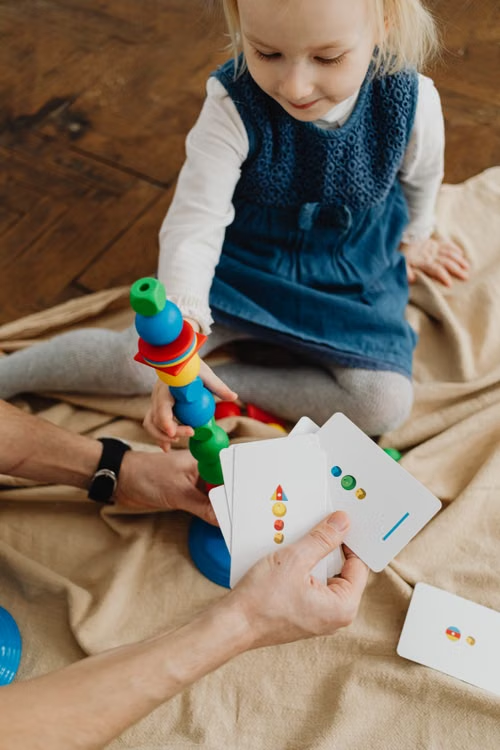
Concrete experiences can also support learning in language, geography, and science. Children may explore objects, maps, pictures, and other materials to build familiarity with a topic before learning more abstract explanations. By working directly with materials and revisiting concepts over time, children can develop a clearer understanding of how ideas connect and apply that understanding to new tasks.
Why Concrete Experience Helps Concepts Stick
Hands-on activities give children opportunities to see, touch, compare, and manipulate materials as they learn. These experiences can help make unfamiliar concepts easier to understand and remember.
Materials also show mistakes clearly. If the beads do not match the numeral, children can see it and correct it themselves, building confidence and independence. Harvard’s Center on the Developing Child shares play-based activities that build brain architecture for infants, toddlers, and older children.
Hands-On Learning at Home
Let your child measure ingredients, sort laundry by color, count stairs, or build with blocks. Trace letters in a tray of salt or sand. Ask your child to show you an idea before you explain it, and resist the urge to hurry toward the answer. Even simple routines, like setting the table, give children chances to count, compare, and solve problems.
How We Help Families
At Montessori School of Chantilly, children have opportunities to learn through hands-on activities and explore concepts at their own pace. Our teachers guide learning based on each child’s development and readiness. Families interested in our child care and preschool programs can contact us to learn more about the classroom environment and learning experiences at their preferred location.
Interested in how Montessori supports hands-on learning for children? Contact our team to learn more about our programs in Virginia and Minnesota.
