
As parents, we spend so much time thinking about what our children eat. We want them to have nutritious meals, develop healthy eating habits, and enjoy a variety of foods. But how often do we stop to think about how safely those foods are prepared and served? As the founder of a child care center in Chantilly, I know that the foods we consider harmless can pose serious risks to young children. A grape, a piece of candy, or an unexpected allergic reaction can turn an ordinary moment into an emergency.
A Tragic Story Every Parent Should Know
In September 1997, a 16-month-old boy in San Francisco tragically died after choking on a whole grape while attending a child care home. According to a news report, the caregiver did not immediately call 911. Instead, she contacted the child’s father, who rushed to the facility and attempted to save his son. Imagine being that parent. Something as ordinary as a grape changed a family’s life forever. You can read the full story in the San Francisco Chronicle.
This heartbreaking incident reminds us that food safety is not just about nutrition. It is also about preparation, supervision, and knowing exactly what to do when something goes wrong.
1. Know Which Foods Can Cause Choking
Young children are still developing the ability to chew and swallow safely. Foods that are round, hard, sticky, or difficult to chew can become choking hazards. Grapes should never be served whole to young children, so cut them lengthwise into quarters or smaller pieces appropriate for their developmental abilities. Avoid popcorn, whole nuts, hard candy, gummies, and other choking hazards for young children.
Cut hot dogs lengthwise into thin strips rather than round slices. Cook hard vegetables, such as carrots, until soft, and prepare them in age-appropriate pieces. Be mindful of large chunks of cheese, meat, and other foods that can be difficult to chew. The CDC lists common choking hazards for infants and young children, and the list is worth keeping on your refrigerator. A food does not have to be unhealthy to be dangerous. Even nutritious foods can present choking risks if they are not prepared correctly.
2. Make Mealtimes Safe and Calm
Children should always sit while eating. Avoid allowing young children to walk, run, play, or lie down with food in their mouths. Eating in a moving car or stroller can also make it harder to notice when a child is choking. Keep mealtimes calm and avoid rushing children.
Most importantly, supervise young children closely while they eat. Being nearby is not the same as actively watching. Teachers in our infant care and Toddler & Pre-Primary classrooms know that attentive adults make the biggest difference at this age.
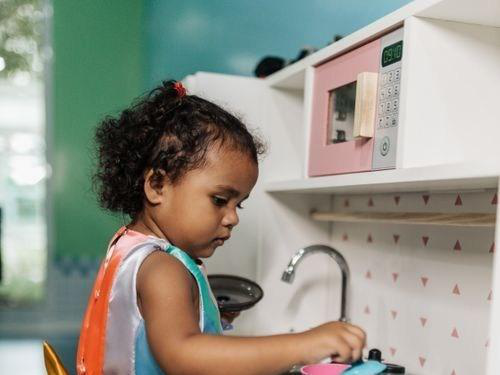
Kitchen role-play lets young children explore mealtime routines before handling real foods with adult supervision.
3. Food Allergies Can Develop Unexpectedly
A child can develop a food allergy even after previously eating that food without a reaction. Food allergies can involve milk, eggs, peanuts, tree nuts, wheat, soy, fish, and shellfish. According to the CDC, approximately 1 in 13 children in the United States has a food allergy.
Symptoms may include hives, swelling, vomiting, coughing, wheezing, or difficulty breathing. If your child develops unusual symptoms after eating, take them seriously and seek medical care. Every child care center in Chantilly should also know how to recognize these warning signs and respond quickly.
4. Know What to Do During an Allergic Reaction
Some allergic reactions can become life-threatening very quickly. If your child experiences difficulty breathing, swelling of the tongue or throat, collapse, or other signs of anaphylaxis, act immediately. Administer prescribed epinephrine when indicated by the child’s emergency action plan and call 911. If epinephrine is unavailable, call 911 immediately. Do not wait to see whether a severe reaction improves on its own. Hives alone do not always mean anaphylaxis, but they should never be ignored.
If your child has a known food allergy, work with your pediatrician to develop an emergency action plan and ensure that everyone caring for your child understands it. The CDC offers helpful information on food allergies and emergency preparedness in schools and child care settings. I also encourage parents and caregivers to learn infant and child CPR and choking first aid. These are skills we hope never to need, but they can save a life.
5. Teach Children Not to Share Food
Sharing is something we encourage in many areas of childhood, but food is an exception. Teach your children that they should not share snacks, lunches, or treats with other children without adult permission. What is safe for one child may cause a serious allergic reaction in another. Families whose children attend a preschool and daycare in Chantilly, VA, can reinforce this lesson at home. This simple habit helps children understand food safety and consider the needs of others.
6. Working Together to Keep Children Safe
At Montessori School of Chantilly, we take food safety seriously. Our schools are nut-free, and we ask families not to send peanuts, tree nuts, or products containing them. We also care for children with allergies to foods such as eggs, dairy, and shellfish, as well as those with gluten-related dietary restrictions. Our enrollment details and safety practices reflect this commitment.
We encourage parents to keep us informed about any food allergies, dietary restrictions, new diagnoses, or changes in their child’s health. If your child has a prescribed EpiPen or emergency allergy action plan, please make sure your school director has the necessary information and medication. In our programs offering infant care and Montessori preschool in Chantilly, VA, communication between parents and educators is one of the most important ways we help protect children.
A Final Thought
As parents, we cannot protect our children from every danger. But we can educate ourselves, recognize risks, and take small precautions that make an enormous difference. Sometimes, protecting a child is as simple as cutting a grape, reading a food label, watching closely during a meal, or knowing when to call for help. Our children depend on us to recognize dangers they are too young to understand.
At our child care center in Chantilly, we believe that raising healthy, confident, and safe children is a partnership between home and school. Let’s continue learning, communicating, and looking out for one another because every child deserves to feel safe at home and at school.
Partner With Montessori School of Chantilly
At Montessori School of Chantilly, we care for infants, toddlers, and preschoolers in nut-free, carefully supervised classrooms where safety comes first. Our teachers work closely with every family to understand each child’s needs, from allergies to mealtime routines. If you have questions about how we keep children safe or want to see our child care center in Chantilly in person, contact us today to schedule a tour.
Kaltun Jama
Founder, Montessori School of Chantilly
