

In an era where digital-first education is becoming the norm, a surprising trend is taking hold of the 2026 parenting world: a return to the physical. While virtual reality and tablets are often marketed as the future of learning, many parents are noticing a side effect: shortened attention spans and a lack of deep focus.
The antidote isn’t found in a new app, but in the palm of a child’s hand. Montessori hands-on education offers a distinct advantage by replacing passive scrolling with active, physical work that grounds a child’s concentration in the real world.
The Passive Screen vs. The Active Hand
When a child interacts with a screen, the engagement is largely reactive. Bright lights, fast-paced transitions, and instant sounds provide a dopamine loop that keeps them plugged in without requiring much effort. This is passive learning; the device does the heavy lifting while the child simply follows along.
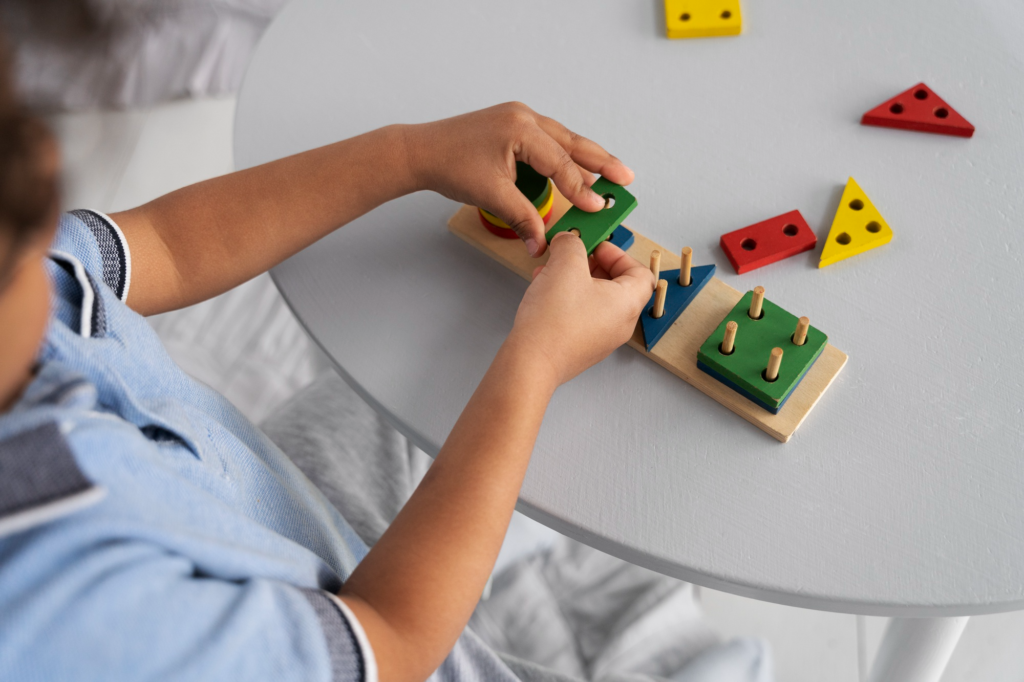
In contrast, the Montessori classroom uses materials designed to stimulate the brain through the sense of touch.
The Pink Tower: Building More Than Blocks
Take the Pink Tower, for example. It isn’t just a set of ten pink cubes. As a child carries each block across the room, they feel the weight change. They must judge the size and dimensions physically. If the tower is off-center, it falls. This immediate, physical feedback requires a level of focus that a digital game cannot replicate. It builds a foundation for mathematical thinking and spatial awareness through pure, uninterrupted concentration.
Sandpaper Letters: A Bridge to Literacy
Similarly, the Sandpaper Letters turn the abstract concept of the alphabet into a physical experience. Instead of tapping a letter on a screen to hear its sound, a child traces the textured surface of the letter with their fingers. This muscle memory creates a stronger neural connection than a pixelated image ever could. By involving the senses of sight, touch, and sound simultaneously, the child develops a longer attention span because they are deeply involved in the process, not just a spectator to it.
Fun Fact: A Montessori school observed that “the hand is the instrument of intelligence.” Modern neuroscience supports this, showing that fine motor skill development is directly linked to the parts of the brain responsible for executive function and emotional regulation.
Why 2026 is the Year of Tactile Learning
Parents today are seeking a balance. We see the value of technology, but we also recognize that the early years, from infancy through kindergarten, are when the brain’s wiring for focus is established. By choosing a Montessori school in Chantilly, VA, or Blaine, MN, you are giving your child the chance to master their environment before they master a device.
This tactile approach ensures that when they do eventually use technology, they have the internal discipline and mental stamina to use it as a tool rather than a crutch.
Stop Scrolling, Start Growing: Join Our Montessori Family!
Are you ready to see the difference a screen-free, hands-on environment can make for your child? At Montessori School of Chantilly, we prioritize the physical and cognitive development that comes from real-world exploration and expert guidance.
We invite you to visit us and see our prepared environments in action. Whether you are looking for an infant program or an accredited kindergarten, we are here to support your child’s natural growth.
Contact us today to schedule your personal tour at any of our three locations:
- Chantilly, VA Campus (Brookfield)
- Chantilly, VA Campus (Technology Court)
- Blaine, MN Campus
We look forward to meeting your family and showing you why our tactile approach is the perfect fit for the modern child!
